All posts by Jeremiah Campbell

testing

On Tuesday, we worked on basics, then I tested Shaun and Stavros.  Both did fine.  Afterwards, we worked on kumi jo.

Last night, Friday, was Downtown night.  Rhiannon helped me set up.  It always seems to be windy when we set up – maybe because it is getting towards dusk.  Still, we managed.  She also walked around and handed out flyers, for a bribe of spring rolls.

basics are important too

Today we worked on ikkyo and shihonage for 6th kyu, 5th kyu, and 3rd kyu.  None of us are so good (me included) that we can not benefit from more basics.

We also worked on flow – doing kote gaeshi and flowing to maximize effectiveness and minimize effort.  We did it a la Barbarella, with a sword, and empty handed.  All of these ways should be the same.

Flow is particularly important for smaller people, as they can’t just muscle their uke when they don’t quite get it.  But if you move well, even a small person can be effective.

However, we then worked on kaeshi waza and henka waza from ikkyo, mostly for the advanced folks.  It is all about flow there too.  For either one, it is important to not take uke back along the same path you used to take his balance.  If you do, you will put him back on balance.  Instead, you should be like the Boers, and go back by a different route.

We did the 7 bokken suburi and shihogiri, then finished up with randori.  Very important to keep moving and keep turning, so people don’t sneak up on you from behind.

good practice

Had a good practice today.  We worked a lot on the motion for kote gaeshi, doing a lot of Barbarella exercises and bokken to work on the movement, both for throwing and ukemi.  Though when we went back to regular kote gaeshi people had to be reminded to keep moving like in the exercises.

At the Hut, there used to be solid steel bars about 1″ diameter cut to 3 and 4′ to represent a bokken or jo.  You had to move your whole body to move those bars.  Maybe we need to get some for Enmei.

We also did a lot of shiho nage and nikkyo.  For any technique, we need to keep thinking about all three parts, but especially kuzushi.  If you take uke’s kuzushi, the rest is easy.  If you don’t, you are vulnerable to a continuation of uke’s attack.  And aikido is a martial art.

There are also three phases in learning a technique.  In the first phase, learning the movements, more than token resistance is counter productive.  In the second phase, learning how to use the technique, reasonable resistance is useful.  In the third phase, practicing executing the technique, resistance is futile.

2-14-16 Happy Valentine’s Day

The downtown event went well, thanks to Rhiannon helping me set up.  It was quite windy, and would have been difficult on my own.  Thanks to the folks who showed up to man the booth.  There were not as many people downtown as I would have expected for Mahdi Gras, but we did chat with half a dozen prospects.

We had our usual Saturday morning class, with a new guy for the first hour.  Welcome Jeff.  He is nidan in TKD and juijutsu.  We worked on testing techniques again, for 6th, 5th, and 3rd kyu.  We finished up with randori, empty hands and then with a jo.

Then I rushed home to drop off Rhiannon and Teddy, and on to the cross training.  We started off with ukemi, as both myself (for aikido) and Ricky (for karate), were going to do some throws.  We segued into throwing with irimi nage, to practice both backward and forward rolls.  Then we did some kaiten nage, which besides being good practice for front rolls was related to what Ricky was going to teach.

Ricky did some throws and takedowns that were a lot like what we do in aikido.  Casey wore me out with a big iriminage-like throw.

Bill Wahne, who just got promoted to 4th dan in Goju Ryu, taught kubitan techniques.  They are definitely painful, and useful for control.

Finally, I taught some exercises on connecting and taking uke’s center.  This allows nage to either do aikido or karate techniques.  We started with uke not moving his feet, and then without designated ukes and nages, with either party able to do a technique if they can.  This is a lot like the tai chi pushing hands technique.  You maintain contact and jockey for advantage, then do a technique.  Usually what led to a successful technique was one partner not being flexible enough.

Overall, the cross training seminar went very well.  Lots of interesting stuff, and nobody got hurt.  I didn’t do a count, but there must have been over 20 people there.

Regular practice, downtown Titusville, and Cross Training

Worked on test material for 5th and 4th kyu and 1st dan. Katate tori (gyaku hanmi) and yokomen uchi are very similar, and shodan is a compilation of all the other tests, so it isn’t hard to find material that is related.

After we got a bit worn out, we started working on aiki jo.  What we do in aikido is probably as similar to jodo as aiki ken is to kendo.  The moves are similar, but the emphasis is different.  Jo work is important as it involves a different ma ai.  It also helps to improve movement.  At the Hut, we used to use heavy metal weapons.  This makes it even more important to move from the hips (center).

We did the first 10 jo suburi, then worked on the 1st kumi jo.  Maintaining correct distance and alignment is both important and requires practice.

On the evening of the 12th (Friday), we have another downtown Titusville event.  Doug can not make this one, so I hope lots of others will.

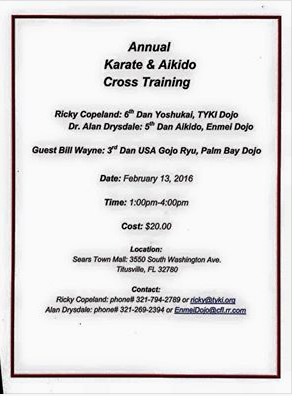
Saturday 13th, 1 – 4, we have our annual cross training seminar with Yoshukai Karate.  Hope to see you all there.

Direction and flowing

Today we worked on throwing in any direction.  Once you have uke’s kuzushi, you can turn in any direction and throw where you wish.  You can do four directions of shihonage, of course, but four directions of any other technique also.  (And four directions implies all directions.)

We also worked on ukemi.  If you flow with a technique, you can redirect it to a harmless direction, and even into another technique: kaeshi waza.  Trying to stop a technique to do kaeshi waza only works on weak techniques, and even then usually leaves you vulnerable to a strike.  Flowing with a technique can result in you being thrown, but there is usually a place in there where you can extend and redirect so that nage no longer has any power.  Even better, redirecting nage’s power usually results in a suki, where you can move in and throw him.

You can not do counter technique if nage takes your balance (kuzushi), and keeps it.  Nor can you do it against somebody at least as strong as you are who has momentum going for him.  But you can take his momentum and move it along a different trajectory, and maybe get his kuzushi.  To do this you have to study ukemi to the point where you no longer think about it, so we worked on kote gaeshi ukemi, flying into a slapping breakfall.  We also did a few falls over a pile of the folding mats.

At the end, we did some freestyle (randori).  Interestingly, the problems were mostly in the initial escape.  People were thinking about doing technique, and messing up the initial part of it.  Accordingly, we did a second round of freestyle, where we just escaped, and did not attempt to do technique.  If you get the escape right, it leads naturally into taking kuzushi, and to the throw.

Time and distance

We spent the practice working on timing and distance.

Timing starts when you see your opponent move.  If there is no unnecessary movement, that is the most efficient technique, and involves the shortest time to the point where you have control.  However, there is always some premotion, or telegraphing.  This adds to the time you have to respond to uke or, if you are the one doing the premotion, to the time uke has to counter your technique.

If you move too soon, uke can change his attack, albeit with reduced effectiveness unless you are way early.  If you move too late, of course you get hit.  Somewhere in the middle is where you should be.  We practiced sen no sen, sen sen no sen, and go no sen from various techniques.

We practiced ki musubi no tachi, then took each of the movements and related it to unarmed techniques.  The first movement, the wrist cut, led to kote gaeshji.  The second, the thrust to the throat, led to a very early irimi nage (sen sen no sen).  We digressed to look at other timings of irimi nage.  The last movement of the kumi tachi was related to ikkyo irimi, entering with the rising arm as uke attacks shome uchi.

None of these, none of aikido, makes sense unless uke is committed to attacking.  But then if uke is not committed to attacking, there is nothing to worry about. Ai‭kido is about harmonising with uke’s energy, which is much easier when there is a lot of it.

We finished up with randori, working on the basics: keeping moving, turning, extension, keeping out of the corners, and keeping track of where everybody is.

Pay attention and respond to the actual attack

Another good class, with six of us there despite the cold weather.  For the first time, I turned on the heat in the dojo.  Guess my blood is getting thin.  A far cry from when Les White used to come into the Hut on a Sunday morning, laugh at us shivering with hoar frost on the mat, and open all the windows.

We started off with some kicking and punching, as we often do these days.  I do want our students to be able to do this well, if only so that our techniques are practiced against realistic attacks.  We also did some blocks and going from a block to a front kick to a spinning back kick.

When we started throwing, I noticed most of us were responding to what attack we expected, rather than what was there.  This is very common due to how we commonly practice in aikido, and is not a good thing.  Aikido began as a martial art, a self defense art, and if it is to be practical, rather than aiki dance, we must learn to read our attacker.

A good uke does not telegraph how he is going to attack.  If an attacker on the street telegraphs, great, but we need to be ready for the one who does not.

Nage should offer a suki (opening) that encourages the attack he wants, and engineer his response to use that attack, but be ready if uke does something different.

An attack is not merely a named attack like kosa dori.  It is a particular kind of kosa dori.  It may involve uke moving forwards or backwards as he grasps the arm, but it should involve uke taking, or attempting to take, nage’s center.  Very probably, uke would grasp nage’s arm in order to control nage so that uke can punch him with his other arm.

Nage can take uke’s center by entering, as for ikkyo irimi.  Or he can let uke take control of his arm and redirect uke’s energy to give an opening for, e.g., kote gaeshi.  What nage should not do is fight a stronger uke.  Even with an uke that is not stronger, struggling to muscle uke is not aikido, which is what we come to the dojo to study.

As an exercise for taking uke’s center, we started with arms in contact as for a shomen strike but static.  Nage practiced feeling and then controlling uke’s center.  Then nage practiced doing a technique from that point.  This initial movement is like kosa dori, so we then reversed roles, with uke taking nage’s center and holding in kosa dori, with nage doing a technique against this energy.  Very different from uke just grabbing nage’s arm as we often practice.

Finally, we had the two partners each attempting to do a technique on the other.  This quickly showed the futility of trying to muscle the other person.  The key is to flow with his energy and using this flow to do the technique – the way of harmony and spirit!
 

Ukemi is important!

Another good showing on Saturday, with another beginner and another prospective one.  With so many beginners, we worked mostly on beginner stuff.  Interestingly, the more advanced people could improve their basic skills also.

In some ways, ukemi is more important than anything else we do.  It is important so that we don’t get hurt, of course.  As uke, we need to flow with the technique, never allowing separation between us and nage.  Yes, we can be stiff, but that almost guarantees injury the first time we work with a nage that is both capable and doesn’t care about hurting us.

Ukemi is also the key to learning aikido.  It is easy for uke to mess up beginners.  Just attack differently each time, and arbitrarily fall or not fall, and the beginner will soon quit in frustration.  Another way to mess up a beginner is to point out every little detail he does wrong, especially if what he is doing isn’t really wrong.  Nage will learn most rapidly if uke gives a consistent attack every time.  Giving corrections and advice is the responsibility of the teacher.  Uke is not the teacher, and should just take ukemi.

I have noticed one or two ukes being lazy.  Especially working with beginners, they will go part of the way into the ukemi, then break off and tell nage they did well.  This weakens the practice for both parties.  It is not uke telling me I have the technique that really matters.  What really matters is that nage learns to feel it when they take control of uke and throw or immobilize him.  They need to feel the technique to completion.

Ukemi is also the key to learning how to do a technique.  By studying how nage moves, how he does the technique, uke can learn how nage makes the technique work, and how to improve when it is his turn to be nage.  It is quite difficult to tell what somebody is doing while watching from the sidelines.  It is almost as difficult to tell what is happening as nage.  It is when you are uke that you can really tell if a technique is working, and why.  This is particularly illuminating when a really great aikidoka throws you, and why people vie for being chosen as uke at seminars.

One problem I noticed is that if nage is too concerned about injuring uke, nage will hold back, and will not feel the effect of his movement on uke.  Of course, nobody wants to injure uke.  (At least nobody I want in my dojo.)  However, uke must get better and better at taking ukemi, so that nage can put more into their technique without injuring uke, and thus both parties learn more.